The Institute for Business and Information Technology announces the 2022 scholarship recipients.

IBIT Alexion Scholarship
Lucas Winslow


IBIT Pfizer Scholarship
Beth Whitehead


IBIT Emtec Scholarship
Austin Yun

IBIT Scholastic Scholarship
Sevgi Sivri


IBIT
Engages with industry to develop digital knowledge and talent
The Institute for Business and Information Technology announces the 2022 scholarship recipients.
IBIT Alexion Scholarship
Lucas Winslow
IBIT Pfizer Scholarship
Beth Whitehead
IBIT Emtec Scholarship
Austin Yun
IBIT Scholastic Scholarship
Sevgi Sivri
Every day, healthcare solutions leader Cencora (a Fortune 10 company) ships pharmaceutical products and treatments to customers such as pharmacies and hospitals. Each shipment leaves from one of the company’s state-of-the-art distribution centers in totes. The totes are durable and designed to be reused — but there was currently no process in place to track what happened to the empty totes after initial use.
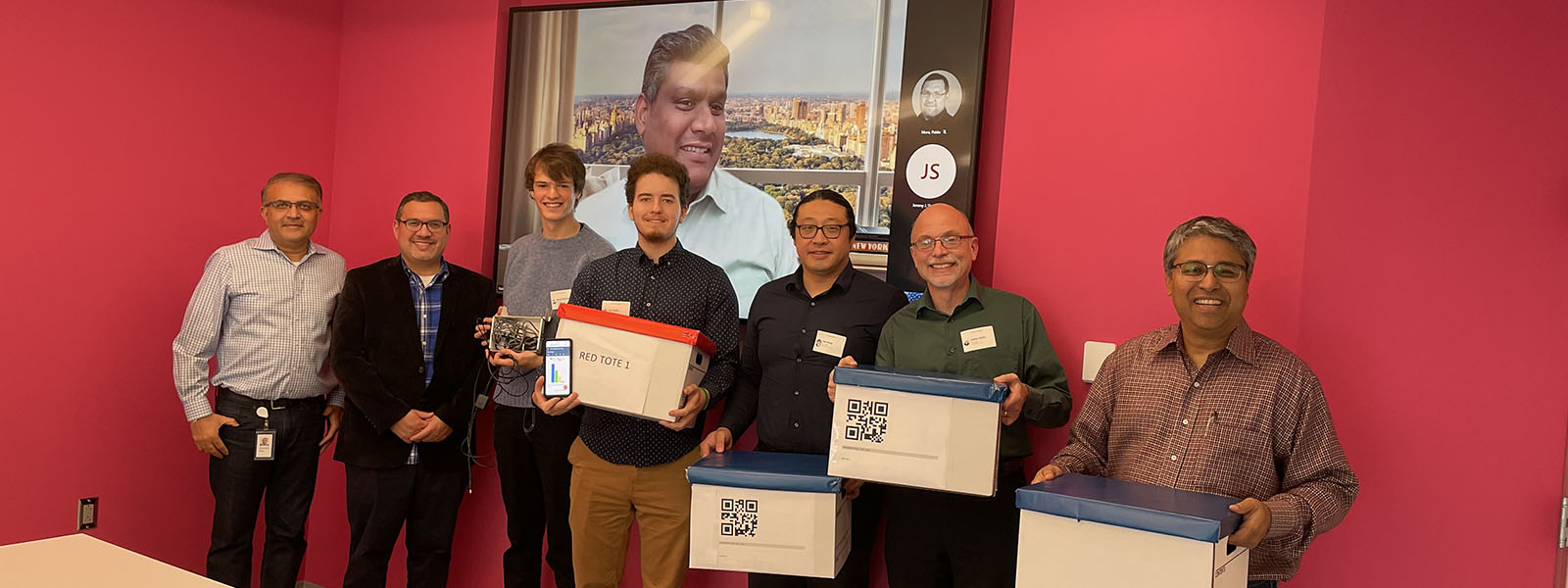
Create an enhanced tracking methodology to track totes, considering cost, reliability, usability, and integration with existing systems. Additionally, the solution should account for change management and its impact on team member processes.




Russell Abernethy, Recipient of the Fall 2022 Digital Innovation Foundry Scholarship
“The work was relevant and useful. We are often heads down into our day-to-day operations, and so greatly benefited from a new perspective that our partnership with the Digital Innovation Foundry brought” Tanmay Bandyopadhyay
Jeremy Shafer and Yan Wang managed this project for DIF
 Lab-scale Testbed for Mixed Human-Autonomous Vehicle Traffic Research
Led by Dr. Philip Dames and students from Temple’s College of Engineering, the project developed a scaled robotic testbed for connected and automated vehicles (CAVs). The testbed can be used to study system-level flow characteristics of mixed human-CAV traffic, which, to date, has received very little attention compared to existing traffic flow or the safety of automated vehicles.
There are many simulation-based studies of traffic, however, there are few experimental results. This project bridges the divide by reducing the cost, effort, and risk. The project will enable the CAV community to (a) rapidly prototype and study levels of connectivity between CAVs and human-driven vehicles, and (b) evaluate coordinated CAVs algorithms to modulate traffic flows.
The DIF project laid the foundation for an NSF award, which is currently under review.

In today’s fast changing environment, the upskilling, development, and engagement of employees has become critical, especially when the economy is near full employment. Led by Munir Mandviwalla, Laurel Miller, and Manoj Chacko, the DIF team is working with Scholastic, Inc. to apply the PRO Community platform to develop and engage employees. To date, a pilot was successfully completed focused on reskilling and retention. A larger scale deployment is being planned.
The platform is now a Temple University spin-off company that applies a data driven, visible, and measurable approach to employee engagement and development.