• Skip to primary navigation
  • Skip to main content
IBIT

IBIT

Engages with industry to develop digital knowledge and talent

  • Home
  • Knowledge
    • AI Analytics Automation Case Competition
    • AI Opportunity Index
    • National Information Systems Job Index
    • Digital Innovation Foundry
      • Digital Innovation Foundry Workshops
    • Quantifying Impact
    • Case studies
    • Projects and Research
    • The IBIT Report
  • Talent
    • Mentoring Program
    • Scholarships
    • Professional Training
    • Prior Talent Development Activities
      • Temple Analytics Challenge
      • National Cyber Analyst Challenge
  • Engagement
    • Advisory Board
    • Executive-in-Residence
    • Symposiums and Conferences
    • Information Technology Awards
    • Prior Engagement Activities
      • Small Business and Non-Profit Digital Transformation
      • Digital Leader Fireside Chats
  • Partners
  • About
    • Mission
    • Annual Report
    • Impact Analysis
    • News
    • Staff
    • Advisory Board
    • Contact Us and Directions
  • Show Search
Hide Search

IBIT News

Frank Fawzi, President & CEO, IntelePeer

Over his four decades in technology, Frank Fawzi has seen multiple waves of innovation. However, witnessing recent advances in AI and the resulting opportunity for business growth, he says, “I’ve never seen anything this large and this rapid.”

At IntelePeer, a leader in the communications automation platform (CAP) market, he is tapping into that opportunity. IntelePeer has 2,500 customers in industries ranging from healthcare and financial services to education and retail. The goal: optimize their customer interactions by voice, text, and more.

We jumped on generative AI in late 2022, and we’ve developed a whole set of capabilities our customers can use to improve automation and self-service rates.

They created their AI Hub and Data Hub, which has enabled IntelePeer clients to reach 85% self-service rates—meaning their customers can resolve their issues without needing a live agent. “Just 24 months ago the best we or anyone else was able to do was maybe 30%, 35%,” Fawzi says.

Appreciating that his passion for “creating great products that improve business outcomes” aligns well with IBIT, he joined the IBIT Advisory Board in 2024.

I’ve always believed that technology has to serve a purpose, and IBIT has a mandate to serve a combination of business, technology, and students and learning all in one.

In addition to Fawzi’s board service, IntelePeer is an IBIT industry partner. Their first project for Temple faculty and students involves IntelePeer and one of its healthcare customers. The business challenge is aimed at using AI to improve the quality and efficiency of the customer’s patient communications. Tens of thousands of patients could benefit, and Fawzi values the chance for real-world impact. 

We have a collaborative triangle to explore how our technology and IBIT’s smart people can lead to value for the patient population and our customer,” Fawzi says. “I can see a lot more projects like this in our future.

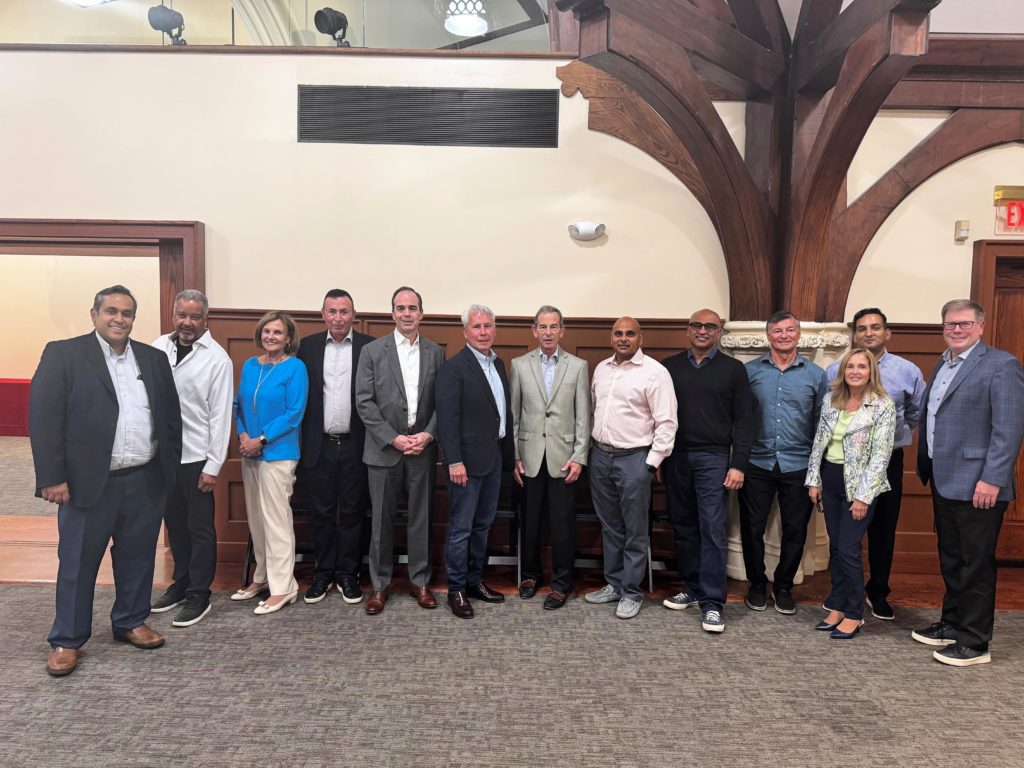
Advisory board meeting – November 2024

The IBIT advisory board meeting on November 6th, 2024, brought together industry partners, faculty, and students for a day of discussion, research, and celebration.

The meeting included opening remarks by newly appointed board chair, Sondra Barbour, and introduction of new members David McGettigan and Frank Fawzi.

Munir Mandviwalla led a discussion about IBIT’s new model for assessing interdisciplinary center impact, followed by a preview of IS Job Index 2024 by Laurel Miller. The meeting featured new research with board member Michael Bradshaw on Kyndryl‘s data liberation and practice modernization.

Manoj Chacko introduced the DIF showcase featuring MovisionHEP – physical therapy at home (Cole Hagen and Yuval Shimoni), Fanalli – fair-priced tickets for genuine fans (Rhea Mohite and Ayush Gupta), and GenAI reliability and transparency (Scholastic – Raghushri Sankaran and Konstantin Bauman).

The evening reception also included posters on AI Opportunity Index (Ziyi (Iggy) Zhao), Embodied Intelligence (David Liang, Lu Lu), and Virtual Pulmonary Rehabilitation (Cole Roberts, Seyedmohammad (Omid) Pourshahid).

The event concluded with a segment recognizing Bruce Fadem, outgoing founding board chair, for his contributions, including acknowledgments from Chip Hunter, Andrea Anania Stewart, Jeff Hamilton, and Munir Mandviwalla.

Directly manage and adjust patient rehab.

DIF is partnering with Omid Pourshahid, Assistant Professor, Lewis Katz School of Medicine, to develop a platform that allows providers to assess and manage patient rehab, and patients’ ability to provide data that is used to regularly adjust their rehab plan.

The role of AI avatars in hospitality

Lu Lu, Associate Professor, School of Sport, Tourism and Hospitality Management and Wangoo Lee, Graduate Fellow are partnering with DIF to explore the role of AI avatars in hospitality. The Embodied Intelligence project will involve comparison and effects of AI avatars on the efficacy of hospitality interactions.

Rethinking the UX of TU Portal

Abey John, Director, Temple Information Technology Services is partnering with DIF to improve the user experience and governance of TUportal – a platform for information and transactions for internal stakeholders.

The DIF team includes Amy Lavin, Associate Professor of MIS who is conducting focus groups to evaluate usability and identify needs. The team also includes Manoj Chacko and Munir Mandviwalla.

  • « Go to Previous Page
  • Go to page 1
  • Interim pages omitted …
  • Go to page 3
  • Go to page 4
  • Go to page 5
  • Go to page 6
  • Go to page 7
  • Interim pages omitted …
  • Go to page 42
  • Go to Next Page »
FOX_Formal_Red_White-300x125

Institute for Business and Information Technology

207 Speakman Hall
1810 N. 13th Street
Philadelphia, PA 19122

About
Staff
Advisory Board
Partners
News
Contact us and directions
LinkedinFlickr

Copyright © 2026 IBIT · Fox School of Business · Temple University · contact us at ibit@temple.edu