• Skip to primary navigation
  • Skip to main content
IBIT

IBIT

Engages with industry to develop digital knowledge and talent

  • Home
  • Knowledge
    • AI Analytics Automation Case Competition
    • AI Opportunity Index
    • National Information Systems Job Index
    • Digital Innovation Foundry
      • Digital Innovation Foundry Workshops
    • Quantifying Impact
    • Case studies
    • Projects and Research
    • The IBIT Report
  • Talent
    • Mentoring Program
    • Scholarships
    • Professional Training
    • Prior Talent Development Activities
      • Temple Analytics Challenge
      • National Cyber Analyst Challenge
  • Engagement
    • Advisory Board
    • Executive-in-Residence
    • Symposiums and Conferences
    • Information Technology Awards
    • Prior Engagement Activities
      • Small Business and Non-Profit Digital Transformation
      • Digital Leader Fireside Chats
  • Partners
  • About
    • Mission
    • Annual Report
    • Impact Analysis
    • News
    • Staff
    • Advisory Board
    • Contact Us and Directions
  • Show Search
Hide Search

DIF Project

Investigating the entrepreneurial potential of immersive applications

Ethan Berg wants to help people build new worlds — professional-quality immersive, 3D spaces and experiences — without any coding skills. Berg (FOX ’20) is the CEO and co-founder of the startup Agora World Inc which offers a drag and drop no-code design space to create spaces for the metaverse.

Berg and Agora won Temple’s Idea Competition in 2021 as well as the Digital Innovation Award from the Digital Innovation Foundry (DIF), which included access to talent and resources. Today, Agora’s no-code platform accommodates users of all experience levels, from professional designers to those with minimal design background, making it an accessible solution for creating professional-quality 3D content and immersive social experiences,” Berg says. “What used to take a team, investment, and months to create now can be created quickly with no code.”   Berg quickly saw the value of DIF talent and resources, to “study this space and get a better understanding of where we’re headed and where we can go.”


Over six months in 2022, the DIF team of Druvakumar Valugubelly (FOX MIS ’22) and Mitchel Zilbershteyn (FOX MIS ’24) supervised by Solon Moreira, Assistant Professor of Strategy and Entrepreneurship applied Agora’s platform to explore commercial metaverse applications.
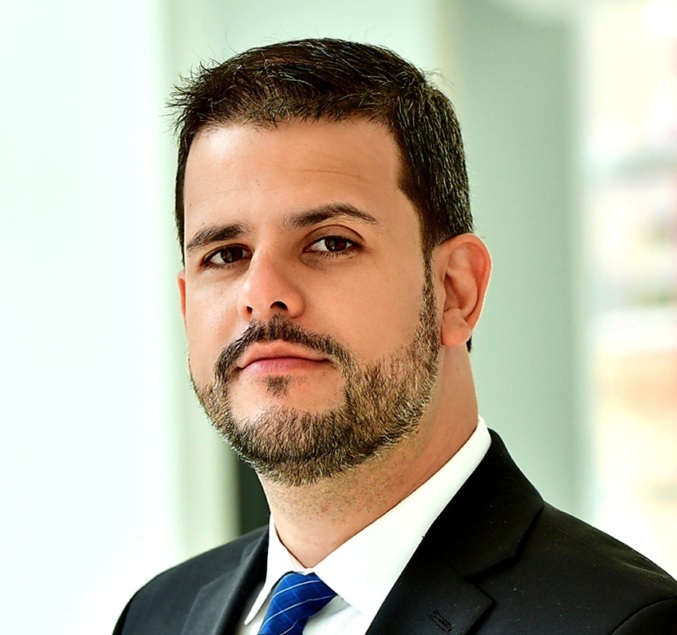
Moreira’s DIF team applied design science research to prototype solutions for three different business problems. The goal was to investigate applications with entrepreneurial potential that are technically and practically feasible for companies. And identify the requirements and resources that companies will need to enact an entrepreneurial metaverse strategy.

The team built three prototype spaces a mall, a neighborhood, and an outdoor concert venue. Visitors to these spaces might shop, go house hunting, or attend a music festival. Moreira explains that a real estate agent could use the neighborhood space to showcase homes in a planned development. Before the foundation of a new house is even poured, a potential buyer could look at the view from “their” balcony. “It was exciting for the Temple team to be part of something that will dramatically change and shape the world of business,” Moreira says.
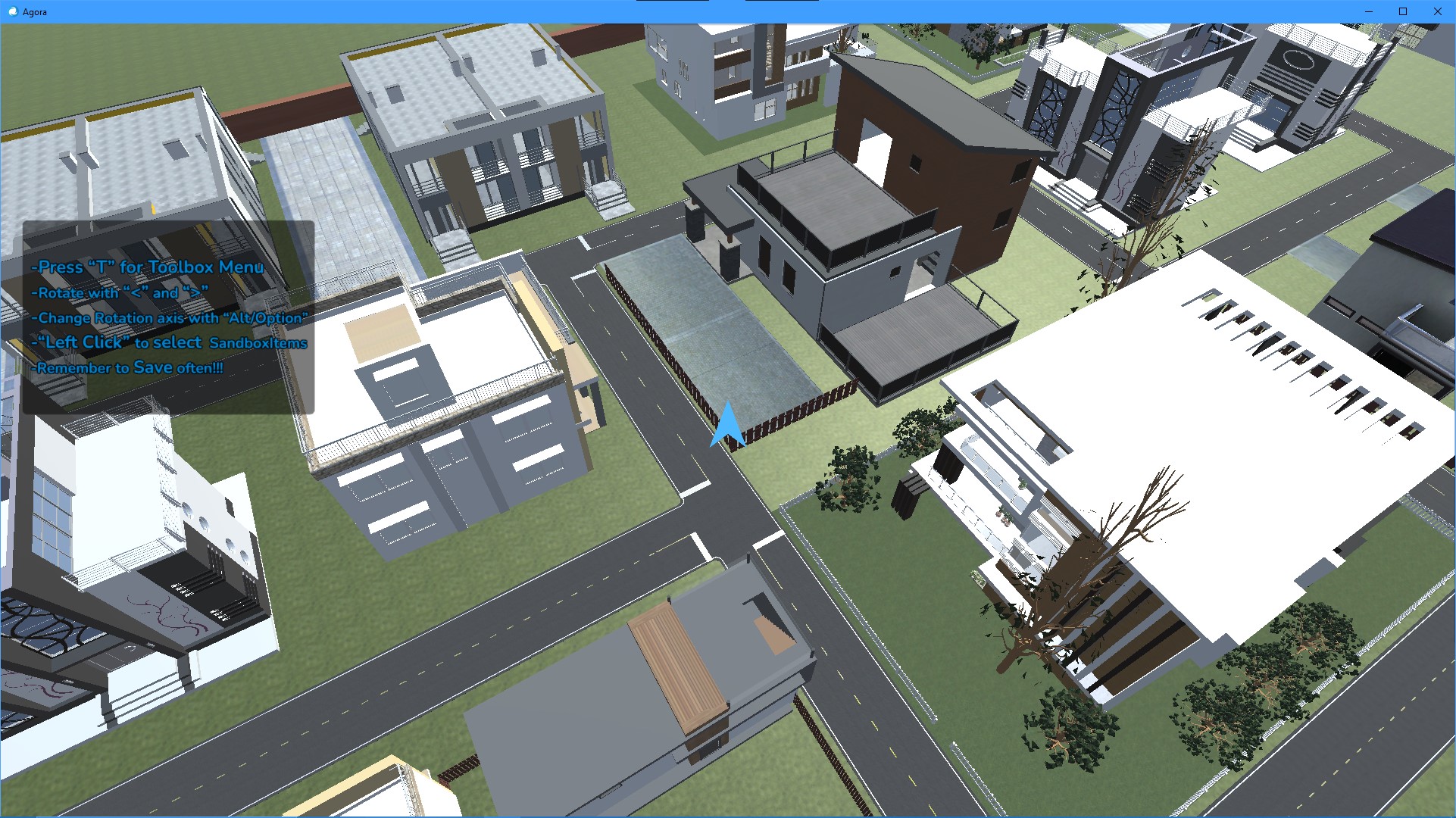
The team presented Berg with valuable feedback, and he was impressed by the “amazing” spaces they built. Valugubelly says he enjoyed the chance to work with LiDAR 3D scanning for the Agora project. “This project helped me better understand how software iteration and testing work,” he adds. Zilbershteyn, says that DIF provides “a valuable connection to industry experts, and the opportunity to engage with professors on research.” “As we continue to evolve, collaborating with the DIF team has provided valuable insights, helping us refine our platform and better serve the diverse needs of our users,” Berg says.

The DIF project also generated new research. Moreira worked with Executive Director and Professor Munir Mandviwalla on a manuscript – “Exploring Entrepreneurship in the Metaverse: Design Requirements and Resources” – which has been accepted at the 18th International Conference on Design Science Research in Information Systems and Technology (DESRIST 2023). Going forward, DIF is collaborating with Agora on additional research and is hosting an integrated industry-research workshop on the business application of metaverses, AR, VR, MR, and digital twins.

The mission of DIF, part of the Institute for Business and Information Technology (IBIT), is to generate innovation by assessing, integrating, and prototyping digital technologies in collaboration with industry, startups, faculty, and students. See: https://ibit.temple.edu/DIF

Learn more about Agora at: https://agoravr.world/

Digitally transforming peer-to-peer car buying and selling

Yousif Memon’s (CST ’17) passion for cars has transformed into an app that is transforming peer-to-peer purchasing of automobiles.

Kuaay began in 2020 when Memon returned to Temple University for Techstars’ “Startup Weekend.” He, along with Keenan Hawekotte, won the competition for their pitch which evolved into Kuaay – a peer-to-peer car buying platform.

Since then, according to Memom we’ve added payment transfer, DMV docs for all 50 states, VIN check, vehicle valuation tools, and shipping to the app. That means the next time I go out to buy a car, my phone is all I need. No more paper and pens, no waiting for the bank to open, and no begging friends and family for rides. I can get the car home and register right on my phone.

IBIT’s Digital Innovation Foundry (DIF) connected with Kuaay through their entry into Temple’s Idea Competition. DIF’s initial goal was to assist Kuaay on implementation and platform architecture. DIF brought in Stephen Hullender, now a recent Temple Computer Science graduate (CST’22), to lead the implementation of a key enabler for Kuaay – notary capabilities.

Now, Hullender has expanded his role into design and navigation and developing algorithms to ease transactions between two parties, especially across state lines. Learning how a mobile app works and contributing to the app’s development improved my confidence. I was able to obtain a wide breadth of knowledge in software development and architecting a solution.

Memon notes we came out of the gate solving niche problems for real people and are on the way to solve bigger problems for even more people by digitizing the entire purchase, shipping, and registration cycle associated with peer-to-peer car buying. Memon added that DIF support and platform architecture guidance has been invaluable in helping us move forward.

Manoj Chacko, Associate Director, IBIT, who manages the DIF – Kuaay relationship including providing advice on platform architecture, notes: Kuaay has the potential to completely digitize and simplify the way someone sells or purchases a used car across state lines.

Going forward, DIF is expanding its relationship with Kuaay into business mentoring and researching the used car buying market.

The mission of DIF which is part of the Institute for Business and Information Technology (IBIT) is to generate innovation by assessing, integrating, and prototyping digital technologies in collaboration with industry, startups, faculty and students. See: https://ibit.temple.edu/DIF

Learn more about Kuaay at: https://www.kuaay.com/

Cencora – Digitally transforming the tracking of pharmaceutical products

Every day, healthcare solutions leader Cencora (a Fortune 10 company) ships pharmaceutical products and treatments to customers such as pharmacies and hospitals. Each shipment leaves from one of the company’s state-of-the-art distribution centers in totes. The totes are durable and designed to be reused — but there was currently no process in place to track what happened to the empty totes after initial use.

DIF Role

Create an enhanced tracking methodology to track totes, considering cost, reliability, usability, and integration with existing systems. Additionally, the solution should account for change management and its impact on team member processes.

Cencora Representatives

Pablo Mora
Cencora
Dharmesh Patel
Cencora

DIF Consultant

Russell Abernethy
Russell Abernethy
Computer Science
Eric Wolfe
Mechanical Engineering

DIF Awards

Russell Abernethy, Recipient of the Fall 2022 Digital Innovation Foundry Scholarship

Impact

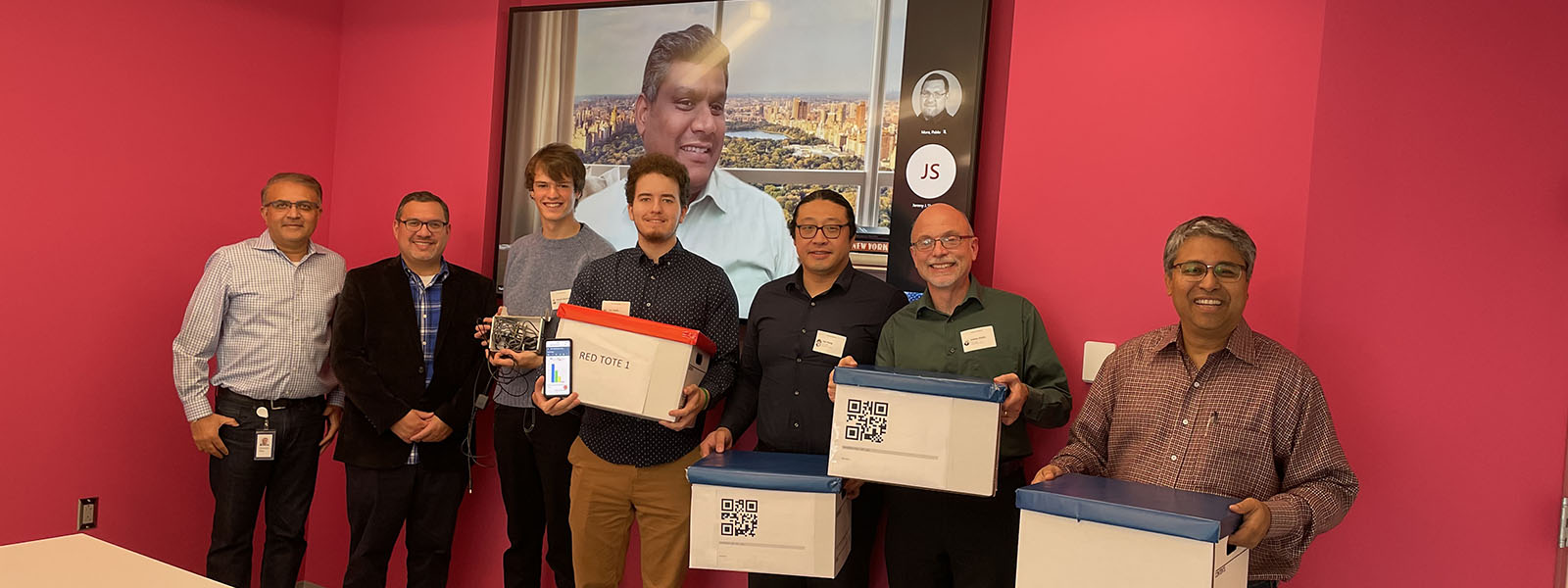
“The work was relevant and useful. We are often heads down into our day-to-day operations, and so greatly benefited from a new perspective that our partnership with the Digital Innovation Foundry brought” Tanmay Bandyopadhyay

 Jeremy Shafer and Yan Wang managed this project for DIF

Lab-scale Testbed for Mixed Human-Autonomous Vehicle Traffic Research

Lab-scale Testbed for Mixed Human-Autonomous Vehicle Traffic Research

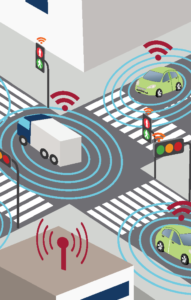
Led by Dr. Philip Dames and students from Temple’s College of Engineering, the project developed a scaled robotic testbed for connected and automated vehicles (CAVs). The testbed can be used to study system-level flow characteristics of mixed human-CAV traffic, which, to date, has received very little attention compared to existing traffic flow or the safety of automated vehicles.

There are many simulation-based studies of traffic, however, there are few experimental results. This project bridges the divide by reducing the cost, effort, and risk. The project will enable the CAV community to (a) rapidly prototype and study levels of connectivity between CAVs and human-driven vehicles, and (b) evaluate coordinated CAVs algorithms to modulate traffic flows.

The DIF project laid the foundation for an NSF award, which is currently under review.

Lab-scale Testbed for Mixed Human-Autonomous Vehicle Traffic Research

Led by Dr. Philip Dames and students from Temple’s College of Engineering, the project developed a scaled robotic testbed for connected and automated vehicles (CAVs). The testbed can be used to study system-level flow characteristics of mixed human-CAV traffic, which, to date, has received very little attention compared to existing traffic flow or the safety of automated vehicles.

There are many simulation-based studies of traffic, however, there are few experimental results. This project bridges the divide by reducing the cost, effort, and risk. The project will enable the CAV community to (a) rapidly prototype and study levels of connectivity between CAVs and human-driven vehicles, and (b) evaluate coordinated CAVs algorithms to modulate traffic flows.

The DIF project laid the foundation for an NSF award, which is currently under review.

  • « Go to Previous Page
  • Go to page 1
  • Interim pages omitted …
  • Go to page 4
  • Go to page 5
  • Go to page 6
  • Go to page 7
  • Go to Next Page »
FOX_Formal_Red_White-300x125

Institute for Business and Information Technology

207 Speakman Hall
1810 N. 13th Street
Philadelphia, PA 19122

About
Staff
Advisory Board
Partners
News
Contact us and directions
LinkedinFlickr

Copyright © 2026 IBIT · Fox School of Business · Temple University · contact us at ibit@temple.edu